
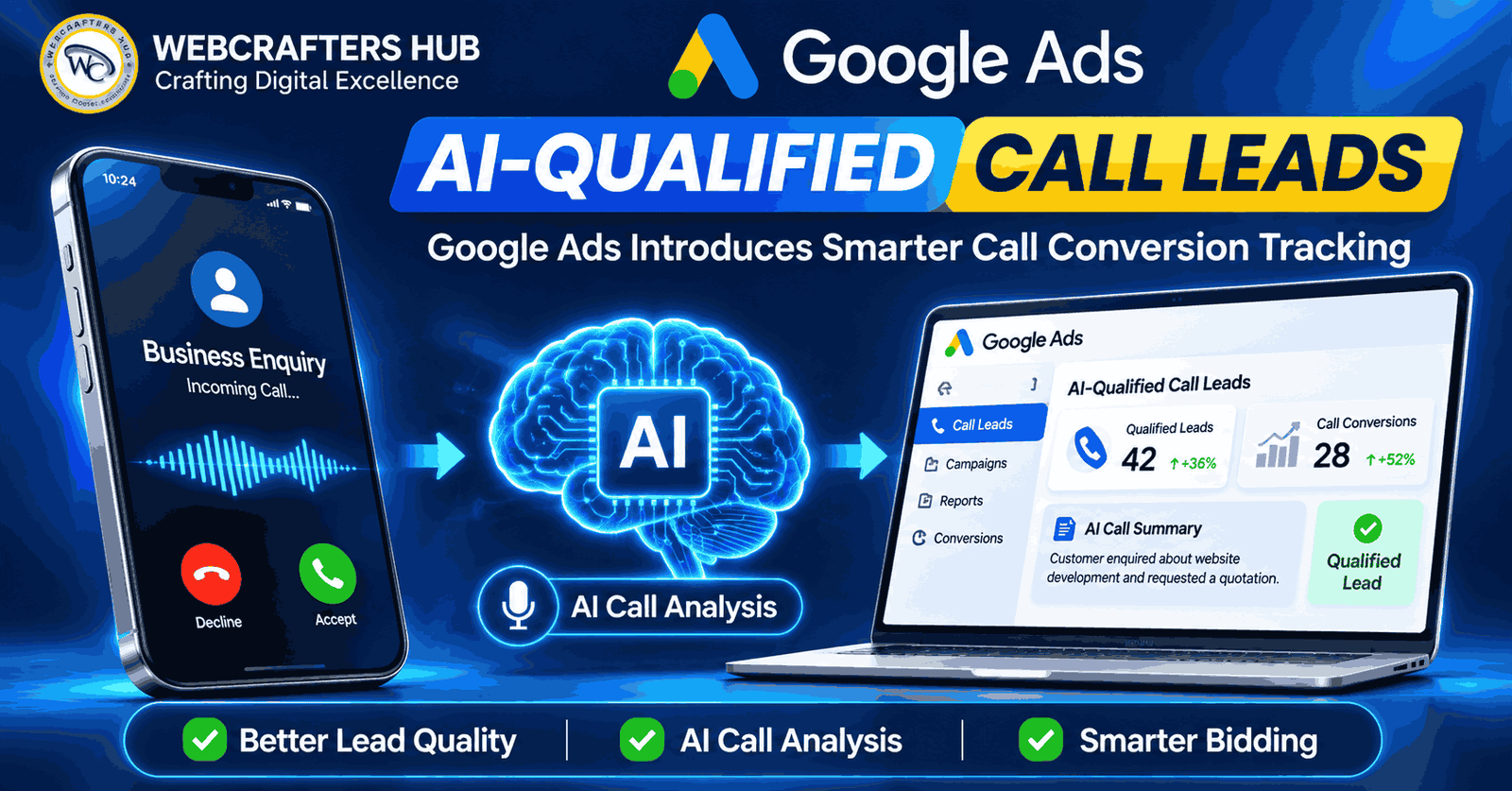
Google Ads is changing how businesses measure the performance of their phone call campaigns. Previously, advertisers primarily relied on call duration to identify successful phone leads. Now, Google is introducing AI-qualified call leads, a feature that uses artificial intelligence to evaluate the quality of phone conversations and identify calls that show genuine customer interest.
This update aims to help businesses distinguish meaningful enquiries from spam calls, robocalls, misdials, and other interactions that may not generate business.
For companies that depend on phone calls to generate enquiries, bookings, consultations, and sales, this could make conversion tracking more meaningful and help improve Google Ads campaign optimization.
In this article, we will explain how AI-qualified call leads work, how Google classifies calls, the role of call recording, how to manage the settings, and what advertisers in India should know about regional availability.
What Are AI-Qualified Call Leads in Google Ads?
AI-qualified call leads are a Google Ads conversion measurement feature that uses artificial intelligence to evaluate phone conversations and identify calls that demonstrate genuine customer interest.
Earlier, Google Ads primarily used call duration as a signal to determine whether a phone call should count as a conversion.
For example, an advertiser might set a minimum call duration of 60 seconds. Any call meeting that threshold could be counted as a conversion, even if the caller was not interested in purchasing a product or service.
However, a long phone call does not always represent a valuable business enquiry.
A call could last several minutes because of:
- A wrong phone number.
- A customer asking an unrelated question.
- A spam or robocall interaction.
- A conversation that does not lead to a business opportunity.
With AI-qualified call leads, Google aims to evaluate the actual conversation rather than relying only on how long someone stays on the phone.
When call recording is enabled and available, Google’s AI evaluates the recorded conversation to identify signals of customer intent.
Examples of positive signals include:
- A customer enquiring about a specific service.
- Someone asking about product pricing.
- A person requesting a consultation.
- A customer discussing service requirements.
- A caller showing readiness to purchase.
- A customer scheduling an appointment.
The objective is to improve the accuracy of call conversion reporting and provide better-quality data for campaign optimization.
Why Is Google Ads Moving Beyond Call Duration?
Call duration has traditionally been an important measurement for phone call campaigns.
However, duration alone cannot accurately determine whether a conversation represents a genuine business opportunity.
Consider a business running Google Ads for website development services.
It receives two calls:
Call 1:
A person calls and speaks for two minutes but only asks for general information. They have no website requirement and no intention of purchasing a service.
Call 2:
A business owner calls for 45 seconds, explains their website requirements, and requests a development quotation.
With traditional duration-based conversion tracking, the first call might qualify while the second call might not meet the advertiser’s minimum call duration.
This creates inaccurate conversion signals.
AI-qualified call leads aim to improve this process by considering the conversation’s intent rather than depending entirely on call length.
Key Benefits of AI-Qualified Call Leads
Google highlights several benefits of this update.
1. Better Lead Quality
The system aims to filter out non-qualified interactions such as:
- Robocalls.
- Spam calls.
- Misdials.
- Other calls that do not represent genuine customer interest.
This can help advertisers understand how many calls are actually relevant to their business.
2. Smarter Google Ads Bidding
Google Ads uses conversion data to help its Smart Bidding strategies optimize campaigns.
When conversion data includes more meaningful customer interactions, automated bidding can receive better signals about the type of users who are likely to become customers.
For example, a company providing digital marketing services may want calls from businesses interested in SEO, Google Ads, or website development rather than general or irrelevant enquiries.
Improved conversion classification can help make campaign optimization more focused.
However, AI-qualified call leads do not guarantee more customers, lower cost per lead, or higher sales. Campaign performance still depends on targeting, budgets, competition, landing pages, and the quality of the business offering.
3. AI-Generated Call Summaries
Google Ads Call Details reports can include AI-generated summaries of recorded calls.
These summaries help advertisers understand the main purpose of a conversation without listening to the entire recording.
Google may also provide hashtags that describe the call’s intent.
Examples include:
- #HighIntent – Indicates strong customer interest.
- #ConsultationScheduled – Indicates that a consultation was scheduled.
These insights can help businesses review incoming calls and understand what potential customers are looking for.
4. Better Conversion Reporting
When call recording is enabled and available, AI evaluates recorded calls and counts only qualified calls as conversions under this primary classification method.
This aims to reduce conversions generated by irrelevant calls that previously qualified only because they crossed a minimum duration threshold.
How Does AI-Qualified Call Lead Classification Work?
Google uses a tiered approach to classify phone call conversions.
The system uses three levels of signals to help ensure advertisers do not miss conversion opportunities.
1. Primary Signal: Call Recording
When call recording is enabled and available, Google records calls and evaluates them using AI.
The system looks for customer intent, such as:
- Enquiring about a service.
- Asking about pricing.
- Requesting a quotation.
- Scheduling a consultation.
- Showing interest in purchasing.
Under this method, only calls classified as qualified count as conversions.
2. Secondary Signal: Call Duration
If a call cannot be recorded, Google uses call duration as the secondary conversion signal.
In this situation, a call can count as a conversion if it meets the advertiser’s configured minimum call duration.
Advertisers can update this duration threshold through their Google Ads conversion settings.
3. Tertiary Signal: Ad Interaction
In rare cases where a Google forwarding number is unavailable, Google uses ad interaction data to classify conversions.
This provides another signal when call recording and the normal duration-based method cannot be used.
Understanding the Classification System
| Classification Level | Signal Used | Purpose |
|---|---|---|
| Primary | Call recording and AI | Evaluate actual conversation quality |
| Secondary | Call duration | Measure calls that cannot be recorded |
| Tertiary | Ad interaction | Provide a fallback conversion signal |
This approach is designed to improve conversion measurement while retaining alternative signals when recording is unavailable.
Is Google Ads Call Recording Turned On by Default?
According to Google’s update, call recording is now turned on by default for eligible accounts to provide AI-qualified call lead insights.
However, there are exceptions.
Call recording will remain turned off if:
- The advertiser previously disabled call recording.
- Google identified the business as operating in healthcare.
- Google identified the business as operating in financial services.
Businesses in these categories may manually enable call recording where eligible.
Advertisers should review their account settings to understand whether call recording is enabled.
Important: Is AI-Qualified Call Recording Available in India?
This is one of the most important points for Indian advertisers.
According to Google’s current documentation, call recording is available only when both the dialing phone number and the receiving phone number are located in the United States or Canada.
This means advertisers using Indian phone numbers should not assume that the AI call recording and evaluation feature is available for their campaigns.
For example:
- An Indian advertiser receiving calls on an Indian phone number does not meet the stated US/Canada recording requirement.
- A call involving eligible US or Canadian dialing and receiving numbers may meet the regional requirement, subject to other eligibility conditions.
When calls cannot be recorded, Google can use the secondary call-duration signal, provided the required call reporting setup is available.
This distinction is important for businesses in India that depend heavily on phone calls from Google Ads.
Before changing your campaign strategy, check the latest regional eligibility and call reporting settings in your Google Ads account.
How to Update the Call Duration Threshold in Google Ads
If you want to change the minimum call duration used as a conversion signal when recording is unavailable, follow these steps:
- Sign in to your Google Ads account.
- Navigate to Goals.
- Open Summary.
- Find and expand Phone call leads.
- Search for AI-qualified call leads.
- Select Edit.
- Open the Lead qualification drop-down.
- Enter your preferred minimum call duration in seconds.
- Select Done.
Choose a duration that makes sense for your business and the type of calls you receive.
Remember that call duration is a fallback signal when a call cannot be recorded; it is not the primary AI classification method when recording is available.
How to Turn Off Call Recording in Google Ads
If you do not want call recording enabled, Google provides an option to turn it off.
Follow these steps:
- Sign in to your Google Ads account.
- Open the Admin menu.
- Select Account settings.
- Expand the Call ads section.
- Find the Call recording setting.
- Select Off.
- Click Save.
Review the applicable Call Ads Supplemental Terms and relevant privacy and consent requirements before using call recording.
What Do AI-Generated Call Summaries Tell Advertisers?
AI-generated call summaries can help advertisers understand what happened during a phone conversation.
Instead of depending only on call duration, businesses can get additional context about the caller’s requirements.
For example, a business receiving calls for website development may want to identify whether callers are asking about:
- Business website development.
- eCommerce website pricing.
- WordPress development.
- Shopify store development.
- Website redesign.
- SEO and digital marketing services.
AI-generated summaries and hashtags can help make call reports easier to review.
However, advertisers should still review their call details and verify whether the classified interactions are genuinely valuable to their business.
How Should Businesses Prepare for This Google Ads Update?
Even with improved AI-based conversion measurement, advertisers need a proper campaign and lead management strategy.
Here are some practical recommendations.
1. Review Your Phone Call Conversion Actions
Check how your Google Ads account currently tracks phone call conversions.
Review:
- Call conversion actions.
- Minimum call duration.
- Call reporting settings.
- Conversion counting.
- Primary and secondary conversion actions.
Make sure your conversion setup reflects your actual business goals.
2. Avoid Optimizing Only for Call Volume
Receiving more calls does not necessarily mean generating more business.
A campaign that produces 50 irrelevant calls may be less valuable than one that generates 10 genuine customer enquiries.
Focus on the quality of conversations, qualified enquiries, appointments, and actual sales.
3. Use Proper Call Tracking
Where supported, use Google Ads call reporting and appropriate call conversion tracking.
For businesses operating in regions where AI call recording is unavailable, review call duration and other available conversion signals.
4. Review Search Terms and Keywords
Your campaign keywords influence the type of people who see your advertisements.
Remove irrelevant search terms and focus on keywords that demonstrate genuine purchase or service intent.
For example, a website development company should review whether its ads are attracting people looking for professional website development rather than unrelated free tutorials or jobs.
5. Connect Advertising Data With Actual Sales
Do not stop measuring performance at the phone call.
Track what happens after a customer calls:
- Was the call relevant?
- Did the customer request a quotation?
- Was a meeting scheduled?
- Did the customer purchase?
- What revenue was generated?
This information helps businesses understand the actual return from their advertising investment.
Does AI-Qualified Call Leads Replace Traditional Call Conversion Tracking?
The update changes how Google evaluates calls when recording is enabled and available, but it also retains alternative signals.
Google’s tiered classification system uses call duration when recording is unavailable and ad interaction data in rare situations where a Google forwarding number is not available.
Therefore, advertisers should understand the new classification process rather than assuming that all existing call conversion measurement has been removed.
The objective is to make call conversion reporting more meaningful by using additional information about customer intent.
Final Thoughts
Google Ads AI-qualified call leads represent an important development in phone call conversion measurement.
By moving beyond call duration and using AI to evaluate conversations, Google aims to help advertisers identify more meaningful customer interactions, improve conversion reporting, and provide better signals for Smart Bidding.
However, regional availability is an important limitation. Google’s documentation currently restricts call recording to situations where both the dialing and receiving phone numbers are located in the United States or Canada.
Indian advertisers should therefore review their eligibility and continue monitoring call duration, search terms, lead quality, and actual sales outcomes.
At WebCrafters Hub, we help businesses plan, manage, and optimize Google Ads campaigns with a focus on meaningful enquiries and measurable business results.
Want to improve the quality of your Google Ads leads?
Explore Digital Marketing Services by WebCrafters Hub or contact our team to discuss your advertising requirements.
Source: Google Ads Help – About AI-qualified call leads. Feature availability, eligibility, and settings may change as Google updates its documentation.