Introduction
The internet has made it possible for a chai tapri owner in Varanasi and a fashion designer in Mumbai to sell to the same customer in London — at the same time. E-commerce is no longer a “big brand” game. It’s open to everyone.
But starting an online store without a proper plan? That’s where most businesses lose money, time, and motivation.
In this guide, WebCrafters Hub walks you through exactly how to launch your e-commerce business online — from choosing what to sell, to getting your first order, to scaling with ads. Whether you’re starting from zero or moving your offline store online, this is your complete roadmap.
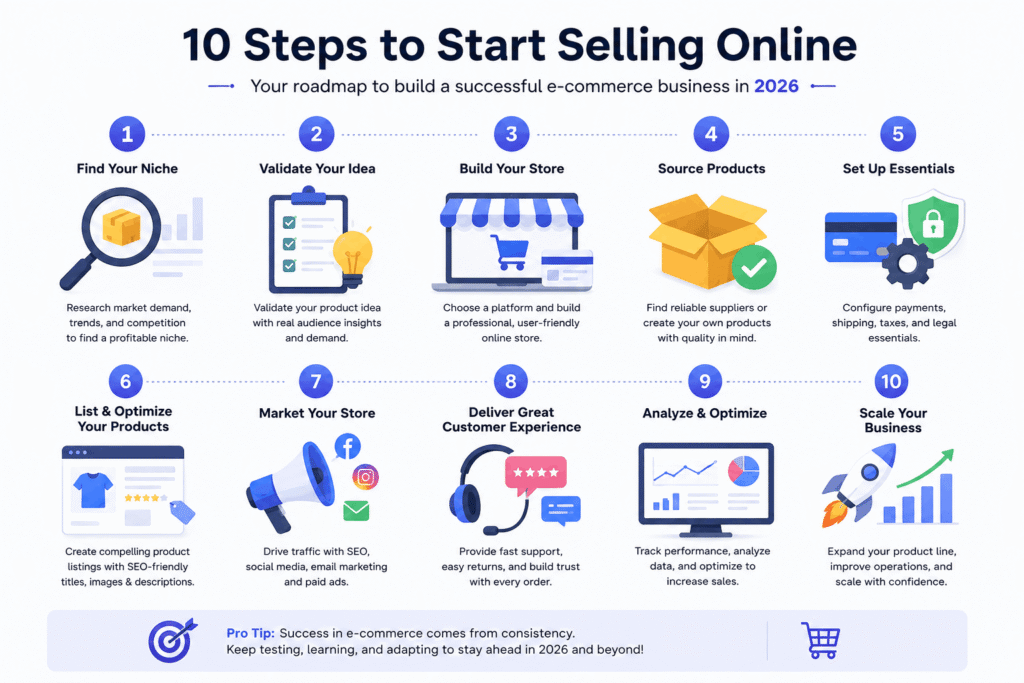
Step 1: Validate Your Product or Niche First
Before you build a website or run a single ad, answer this question: Is there real demand for what I’m selling?
Most new e-commerce sellers skip this step — and it costs them everything.
How to validate your product:
- Search your product on Google Trends and check if interest is growing, stable, or declining.
- Look at Amazon, Flipkart, or Meesho — are similar products selling with hundreds of reviews? That’s proof of demand.
- Check Facebook and Instagram ad library — if competitors are running ads for months, the product is profitable.
- Talk to 10 potential customers. Ask them where they currently buy this product and what frustrates them.
What makes a good e-commerce product:
- Solves a clear problem or satisfies a strong desire
- Has a healthy profit margin (ideally 40–60%+ after all costs)
- Not easily available at every local shop
- Can be explained in one sentence
If your product passes these checks, you’re ready to build.
Step 2: Choose the Right Business Model
Not all online selling is the same. Pick a model that fits your budget and goals:
1. Inventory-Based Model You buy or manufacture products, store them, and ship them yourself. Higher risk, but higher margins and full control over quality. Best for: Local manufacturers, artisans, wholesale buyers
2. Dropshipping You sell products you don’t physically own. When a customer orders, your supplier ships directly. Low investment, but lower margins and supplier dependency. Best for: First-time sellers testing the market
3. Print on Demand You design products (T-shirts, mugs, notebooks) and a partner prints and ships on order. Zero inventory risk. Best for: Designers, content creators, personal brands
4. D2C (Direct to Consumer) You manufacture your own brand and sell directly online — no middlemen. Best margins, strongest brand. Best for: Homemade products, niche brands, premium categories
Step 3: Build Your Online Store
Now you need a place for people to actually buy from you. You have two main paths:
Option A: Your Own Website
Having your own e-commerce website is the most professional and scalable choice. You own your customers, your data, and your brand.
Recommended platforms:
- WooCommerce (WordPress) — Most flexible, SEO-friendly, ideal for Indian businesses. Requires a hosting plan.
- Shopify — Easiest to set up, but monthly fees add up. Great for scaling fast.
- Dukaan / Instamojo — Indian-made platforms, quick to set up, Hindi support.
What your website must have:
- Fast loading speed (under 3 seconds)
- Mobile-first design (70%+ of Indian shoppers browse on phones)
- Clear product images and descriptions
- Easy checkout with UPI, cards, and COD options
- SSL certificate (the padlock in the browser — builds trust)
- Return and refund policy page
- Contact and about us page
At WebCrafters Hub, we build WooCommerce stores that are fast, SEO-ready, and conversion-optimised for Indian buyers. If you need help, you know where to find us.
Option B: Sell on Marketplaces First
If you’re not ready to invest in a website, start on:
- Amazon India / Flipkart — Massive traffic, but heavy competition and fees
- Meesho — Great for budget-category products
- Etsy — Perfect for handmade, vintage, or unique products
- Instagram / WhatsApp Shops — Ideal for local or personal brands
Pro tip: Don’t stay on marketplaces forever. Build your own website as soon as possible. Marketplace fees eat 15–30% of your revenue, and they own your customer relationship — not you.
Step 4: Set Up Payments and Logistics
Payment Gateways for Indian E-Commerce
You need a reliable payment gateway that accepts UPI, cards, net banking, and wallets. Top options:
- Razorpay — Most popular for Indian D2C brands. Easy integration.
- PayU — Good for WooCommerce stores.
- Cashfree — Growing fast, competitive rates.
- Instamojo — Simple, good for beginners.
Also offer Cash on Delivery (COD) — in India, a significant portion of shoppers still prefer COD, especially in Tier 2 and Tier 3 cities.
Shipping and Delivery
- Shiprocket — Aggregates 17+ courier partners. Best pricing for small sellers.
- Delhivery / Blue Dart / Ecom Express — For direct tie-ups once your volume grows.
- Self-delivery — Works if you’re selling locally.
Set clear delivery timelines and always send tracking updates. Nothing kills repeat business faster than silence after a purchase.
Step 5: Write Product Listings That Actually Sell
Your product page is your salesperson. Most people write boring descriptions — that’s your opportunity.
A great product listing has:
- Headline: Clear, benefit-driven product name. Not “Cotton Kurta — Blue” but “Breathable Summer Cotton Kurta — Stays Cool All Day”
- Images: Minimum 4–6 photos. Include lifestyle shots (product in use), close-ups, and size reference.
- Description: Lead with the benefit, then features, then specs. Write like you’re talking to the customer.
- Social proof: Reviews, ratings, number of orders sold
- FAQs: Answer the top 5 questions customers would have before buying
- Clear CTA: “Add to Cart”, “Buy Now”, “Order on WhatsApp”
SEO tip: Include your main keyword (e.g., “organic face cream for oily skin”) in the product title, first paragraph of description, image alt text, and meta description.
Step 6: Drive Traffic to Your Store
Building a store is only half the job. Now you need people to find it.
1. Search Engine Optimisation (SEO)
SEO brings free, long-term traffic. Optimise your:
- Product pages for specific search queries
- Category pages for broader keywords
- Blog section for informational searches (like this article!)
- Google My Business listing if you have a physical presence
Results take 3–6 months, but the traffic is free and compounds over time.
2. Google Shopping Ads
When someone searches “buy leather wallet online” on Google, the product images that appear at the top are Google Shopping ads. These are extremely high intent — the person is ready to buy.
Google Shopping campaigns work brilliantly for e-commerce if set up correctly with proper product feeds, bid strategies, and negative keywords.
3. Meta Ads (Facebook & Instagram)
Meta ads are the engine of most D2C e-commerce brands in India. You can:
- Target by interest, age, location, and behaviour
- Run carousel ads showing multiple products
- Retarget people who visited your website but didn’t buy
- Use video reels to introduce your brand to cold audiences
Start with a small test budget (₹300–500/day), test 3–4 creatives, and scale what works.
4. Instagram & Organic Social Media
Post consistently — product photos, behind-the-scenes content, customer reviews, packing videos, founder stories. Indian buyers trust brands they’ve seen multiple times on social media before purchasing.
Use relevant hashtags, collaborate with micro-influencers in your niche, and engage with comments and DMs promptly.
5. WhatsApp Marketing
India runs on WhatsApp. Build a broadcast list of existing customers and interested leads. Send:
- New product launches
- Flash sale announcements
- Personalised follow-ups for abandoned carts
- Order updates and after-sales messages
Step 7: Convert Visitors Into Buyers
Getting traffic is one thing. Converting that traffic into sales is where the real skill lies.
Conversion Rate Optimisation (CRO) basics:
- Reduce friction at checkout — Every extra step loses customers. Offer guest checkout.
- Show trust signals — SSL badge, return policy, customer reviews, payment logos
- Create urgency — “Only 3 left in stock”, “Offer ends tonight”
- Abandoned cart recovery — Email or WhatsApp reminders to people who added to cart but didn’t buy. This alone can recover 10–15% of lost sales.
- Live chat or WhatsApp button — Many buyers have last-minute questions. Answer them and close the sale.
- Easy returns — A clear, no-hassle return policy actually increases purchase confidence.
Step 8: Retain Customers and Build Loyalty
Acquiring a new customer costs 5x more than retaining an existing one. Your best customers are the ones who’ve already bought from you.
Retention strategies:
- Email marketing — Send post-purchase emails, review requests, and loyalty offers
- Loyalty programme — Reward repeat purchases with discount coupons or points
- Personalisation — “You might also like…” recommendations based on past orders
- Excellent packaging — Unboxing experiences drive Instagram shares and word-of-mouth
- After-sales follow-up — A simple “How’s your order?” message builds tremendous goodwill
Step 9: Track, Analyse, and Improve
You can’t improve what you don’t measure. Set up these tools from day one:
- Google Analytics 4 (GA4) — Track traffic sources, user behaviour, and conversions
- Google Search Console — Monitor your SEO performance and search rankings
- Meta Pixel — Track what happens after someone clicks your Facebook or Instagram ad
- Hotjar or Microsoft Clarity — See heatmaps of how users interact with your website
Key metrics to watch:
| Metric | What It Tells You |
|---|---|
| Conversion Rate | % of visitors who buy |
| Average Order Value (AOV) | How much each customer spends |
| Customer Acquisition Cost (CAC) | What it costs to get one buyer |
| Return on Ad Spend (ROAS) | Revenue earned per ₹1 spent on ads |
| Cart Abandonment Rate | % who add to cart but don’t buy |
Review these weekly. Small improvements in each metric compound into big revenue gains.
Step 10: Scale What’s Working
Once you have consistent sales, it’s time to grow:
- Increase ad budgets on campaigns with proven ROAS
- Expand to new platforms — if you’re doing well on Instagram, test Google Shopping
- Add new products based on what your existing customers ask for
- Launch on marketplaces as an additional channel (not your only one)
- Build your email list — it’s an asset you own, unlike social media followers
- Hire support — content creators, ads specialists, customer service
Growth is systematic, not accidental. Build processes, automate repetitive tasks, and stay focused on what’s actually moving the needle.
Common Mistakes to Avoid
- ❌ Launching without validating demand
- ❌ Using bad product photos (this kills conversions)
- ❌ Ignoring mobile experience
- ❌ Running ads before your website is conversion-ready
- ❌ Giving up after the first month — e-commerce takes time
- ❌ Not collecting customer emails from day one
- ❌ Competing only on price — build value instead
Final Thoughts
Starting an e-commerce business in 2026 is one of the best decisions you can make — but only if you approach it with a real strategy. The opportunity is massive, the tools are affordable, and the market in India is still wide open in hundreds of niches.
You don’t need a big budget. You need clarity, consistency, and the right guidance.
At WebCrafters Hub, we help e-commerce businesses with everything — from building your WooCommerce store to running Google and Meta ad campaigns that bring real buyers. If you’re ready to take your business online or scale what you’ve already built, let’s talk.
📩 info@webcraftershub.com 📞 +91-8887783951 🌐 webcraftershub.com
Written by Kaif Ali Khan — Founder & CEO, WebCrafters Hub. Digital marketing practitioner helping businesses grow online since 2022.